
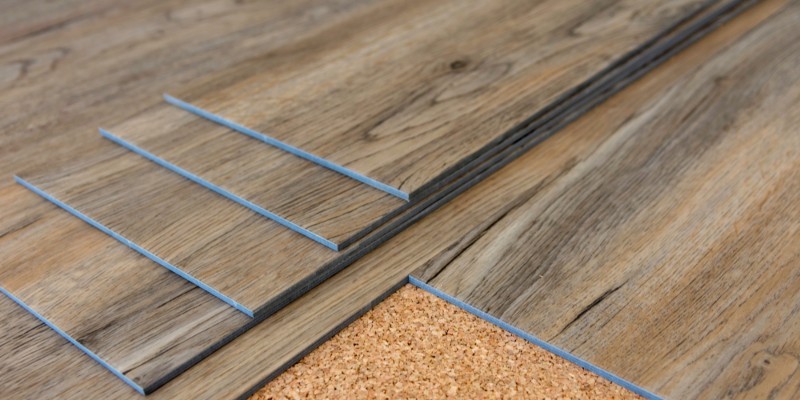
This is a comprehensive vinyl plank flooring guide.
In fact, there is so much information here, we realize that not all of it might be relevant to your research goals.
That’s where the handy Navigation Guide below will help. Use it to jump to the information you want.
What is Vinyl Plank Flooring?
First of all, vinyl plank flooring has other names you’ve probably heard:
These all refer to vinyl plank flooring.
This image of Armstrong LUXE LVP with a Rigid Core center is a good example of vinyl plank flooring construction.

Vinyl Plank Flooring Construction
We’ll make this brief, but here is a layer-by-layer overview starting from the top.
1. Wear Layer
This is the tough, clear layer that protects the beauty of LVP.
2. Luxury Vinyl Layer
This is called the design layer or image layer.
Vinyl (PVC plastic) is a very versatile material. With it, remarkably authentic-looking designs can be produced to mimic wood, stone, ceramic tile and other materials. The designs are printed for outstanding realism.
The vinyl layer is waterproof and can be textured, for example, to give it a genuine woodgrain feel.
3. The Core: Wood or Stone with Polymers
There are two types of cores used: Wood-based and stone-based cores. The wood is often sawdust, aka wood flour, but Cali Bamboo uses bamboo powder. The stone is usually crushed limestone.
The image above shows a stone-based core.
Both wood (or bamboo) and stone are mixed with plastic polymers, so you will see WPC, wood/polymer core, and SPC, stone/polymer core, used in the literature when researching brands.
What’s the difference between WPC and SPC cores?
That’s a great questions for the FAQ section below, but it is worth answering here.
WPC cores are often associated with residential use and SPC cores are thought of as commercial flooring.
But that distinction is blurred. Both types come with residential and commercial warranties – except really cheap LVP which does not have a commercial warranty.
4. Attached Pad
Most luxury vinyl plank flooring includes attached pad.
We prefer cork. It is used on most COREtec cabinet and NuCore LVP. It is soft and dampens noise. LifeProof and a few other brands use HDPE pad which isn’t soft and barely reduces noise.
A few low-cost vinyl plank flooring collections like COREtec One do not have attached pad. If there’s no pad, you might have to install underlayment before installing the LVP.
Installation of Vinyl Plank Flooring
There are four basic types:
1. Interlocking Edges:
Most LVP interlocks, like tongue & groove, to form a floating floor (it’s not glued down).
Most interlocking flooring can be glued, but the pieces have to be joined first. Gluing is usually only used in very large areas where a floating floor might be less stable or where the floor is subject to heavy, rolling loads.
2. Glue Down:
LVP with glue-down design has edges that align closely. The pieces are fully glued (called full spread), and set in place.
Most vinyl planks and tiles with a stone-polymer core (SPC) require glue-down installation.
3. Peel and Stick:
This installation type is usually associated with cheap carpet or vinyl tiles, but some LVP uses it.
For example, Armstrong LUXE uses a technology called FasTak, a tacky backing. Initially, the piece can be picked up and repositioned, if installed misaligned. LUXE is good-quality vinyl plank flooring in the $2.50-$4.00 per square foot range.
4. Loose Lay LVP:
This is small, niche category of luxury vinyl plank and tile flooring.
As the name implies, loose lay flooring has no fasteners or tongue & groove design and does not require glue. The pieces are simply laid on the floor.
Loose lay LVP is ideal for locations where the floor must be removed or taken up and reinstalled frequently.
Summary of LVP Construction
There are two basic types – Wood/polymer and Stone/polymer cores.

WPC flooring is usually associated with residential use because it is softer but less resistant to dents and heavy loads. However, it is suited to light commercial use like office space and light retail.
