

Our goal is to give provide you with a comprehensive laminate floor buying guide for easy research of this popular floor material.
Essential topics are covered with enough depth to provide clarity, but we try not to get bogged down in details.
The Navigation Guide is available if you choose to jump to topics of greatest interest to you.
Thank you for stopping by. Here we go.
What is Laminate Flooring?
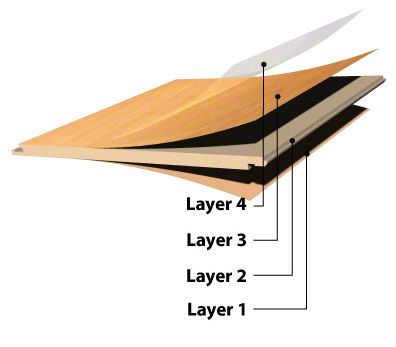
Laminate means layers. This is a rigid flooring type composed of a few main layers.
From the bottom up:
1). The "Backing Layer" is a heat-fused composite layer that has a few purposes. It resists moisture from below, which is important when installed over concrete. And it helps the planks lay flat rather than curling up at the ends.
2). The "Inner Core" is usually medium-density fiberboard, or MDF. Some floors use high-density fiberboard, or HDF. Both are made of wood pulp/cellulose and glue mixed and pressed for bonding and hardness. It's the thickest layer of the laminate.
Note: Waterproof laminate has an inner core that is made from synthetic material rather than organic material. It won't absorb water, so the flooring can be called waterproof rather than water-resistant. See the FAQs below and our Best Waterproof Laminate buying guide for details.
3). The "Design Layer" is also called the photographic layer, pattern layer and décor layer. It is a high-definition photograph of wood (or stone or tile). The quality of the image gives the floor its realistic look. This is the genius of laminate – the look of the real thing at less than 25% of the cost.
4). The "Wear Layer" is a tough, clear topcoat often made from aluminum oxide and melamine. It is resistant to scratches and general abrasion.
What about attached underlayment pad? Our image doesn't show any, but some laminate comes with attached underlayment that saves a step in installation.

The pad is 2 or 3 mils of foam that slightly softens the flooring feel when walked on. It muffles a bit of noise, though you'll want 6 mil sound-reducing underlayment if the laminate is going on an upper floor of a home, apartment building or commercial building.
The underlayment prevents the backing layer from damage as the floor shifts slightly with foot traffic and temperature changes.
Laminate is a floating floor. It isn't glued or nailed down. Each brand has a slightly different tongue & groove connecting system.
The floating design speeds up installation and it allows for the slight expansion/contraction that happens with changes in temperature and humidity.
Laminate Flooring Pros
This section gives more than basic "pros" like the affordability and beauty of laminate. It also discusses options, styles and other benefits this floor type offers.
1. Cost is Affordable
This is the main reason homeowners choose laminate. vs hardwood, stone, ceramic tile and luxury vinyl planks and tile (LVP/LVT).
Check out these cost comparisons for average installed costs.
2. It Looks Like the "Real Thing"
It has the look and feel of what it's replicating – genuine wood, stone or ceramic tile. Actually, it is warmer than stone and tile, so that's an advantage for bare feet and pets in cool weather.
3. So Many Wood Options
This should probably be its own section, since there is so much to cover.
But we'll make it brief, because you'll see for yourself how many options there are as you shop for laminate locally and online.
Species:
There are laminate floor styles in every type of domestic wood used for flooring: Lots of red and white oak, but also ample choices in maple, hickory, cherry, ash, acacia, pine, walnut, mahogany and more.
Then there are the exotic options – not as many, but still quite a few like Brazilian cherry, merbau, tiger maple, chai acacia and bengalwood.
Colors:
Hardwood manufacturers use different stains and techniques to enhance the appearance of wood.
All those "looks" are available in laminate, since the photographs are of genuine wood products.
Wood can be clear-coated or stained to produce amber, ruddy red, honey brown, milk chocolate and a range of charcoal tones. White-washed, bleached and weather wood looks are available too. That's a small sample of options.
Plank Widths, Shapes and Textures:
Planks range from about 3.5 inches that have a modern/contemporary look to those from 6 to 8 inches that generally have a more traditional or rustic look.
A few reclaimed and barn styles use planks of different widths to create a uniquely appearance.
Edges can be squared for a traditional look or beveled in several ways to create additional looks.
1-strip, 2-strip and 3-strip Planks: This means that a single laminate plank will have an image on it of one, two or three wood planks. This technique allows a wider range of appearances from thin, modern looks to wide, beefy rustic and traditional looks.
Plank surfaces can be textured with real woodgrain feel, scraped or hand-scraped like hand-worked rustic wood, smooth like sanded planks and more. A technique called embossed in register, or EIR, produces a very realistic wood texturing.
4. Put it "Anywhere"
For a long time, you couldn't put laminate in bathrooms, laundry rooms and basements (anywhere "below grade", which means below ground level) without voiding the warranty.
Now, moisture-resistant and waterproof laminate is approved by the manufacturers for those locations. – and you have plenty of attractive flooring options.
Speaking of anywhere, this is an ideal floor material for use over a radiant heat system.
And, it's an interesting choice for wall and ceiling paneling too.
5. It is Softer than Tile
This makes it easier to stand on while cooking or cleaning up.
And if you have young, playful children roaming the house, falls on laminate are less risky than tumbles on tile.
6. Inexpensive or DIY Friendly Installation
Other than peel-and-stick carpet and vinyl tiles, laminate flooring is the easy to install.
This means that if you're a fairly handy homeowner, DIY is a definite option.
Or if you’d prefer pro installation, labor costs are lower than for most other floor materials.
7. Low-VOC Options & Allergy Friendly
Most brands make laminate that is certified to be low in volatile organic compounds. See the "Certifications" section below for details.
Generally, laminate is a good choice when someone in the household has allergies or other breathing issues related to poor air quality.
Why? It's simple. Dust and other allergens are easily removed. Laminate doesn't harbor them like carpet does.
8. Easy Care
Laminate can be vacuumed with a hard-floor vacuum or swept with a dry microfiber mop.
For cleaning, a damp microfiber mop is the best for large area. For small, sticky spots, a little spray cleaner and a cloth do the job.
9. Commercial Options
Most major laminate brands make commercial-grade laminate. Commercial warranties are 5, 10 or 15 years.
Laminate Flooring Cons
It’s a very compelling floor material, but laminate isn't perfect.
Keep these potential disadvantages in mind as you compare floor types for your home or commercial setting.
1. Durability Varies
Cheap laminate is a flooring solution of 7-10 years.
Most lasts 10-15 years. Premium laminate should look good for 15+ years. You get what you pay for.
Of course, laminate will last much longer in a home with a "no shoes" policy and a cat than it will where shoes are worn and a large dog roams the home.
We looked at a cost comparison above. Now, here's the longevity comparison: